Why We are Telling This Story?
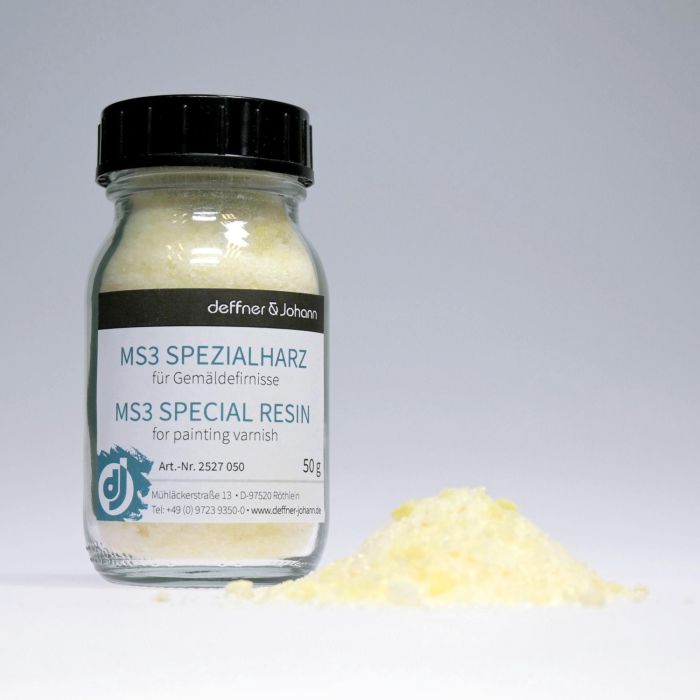
At Deffner & Johann, we don’t just supply materials – we share the science, the challenges, and the innovation behind them. This blog post introduces MS3
MS3, a synthetic varnish resin builds on the trusted legacy of MS2A, a conservation favorite since the 1950s which gained popularity for its superior handling, clarity, and long-term reversibility. After production ceased in 2014, demand for reliable replacement grew.
MS3 not only matches the performance of MS2A but surpasses it in key areas – offering enhanced colour clarity, chemical stability, wetting surface, rapid solubility in both non-polar and polar solvents. MS3 is produced using advanced flow chemistry technology, an innovative manufacturing method that ensures exceptional batch-to-batch consistency, minimizes waste, and significantly improves sustainability. This process enables precise control over resin quality, resulting in a product that is both environmentally conscious and scientifically robust.
In response to the discontinuation of the renowned MS2A resin, CSIRO, Australia’s national science agency, launched a groundbreaking initiative in 2016. Partnering with the Conservation Department of the National Gallery of Victoria (NGV) and chemical innovator Boron Molecular, the goal was clear: to develop a next-generation synthetic resin that meets the evolving needs of the conservation community. The result is MS3 – a state-of-the-art varnish resin engineered specifically for the restoration and preservation of fine art and cultural heritage.
Developed to meet the highest international conservation standards, including the European CEN guidelines, MS3 ensures minimal discolouration, excellent aging performance, and full long-term reversibility. Its improved molecular design makes it an ideal choice for conservators seeking reliable, modern materials tailored for delicate restoration work.
MS3 empowers conservators with a trusted, future-ready varnish solution – already endorsed by prestigious collections and conservation professionals globally.
»"Since 2020, MS3 synthetic resin has been an integral material in our conservation studios, following the success of MS2A,” states Diploma Conservator Hajk Hovhannisjan; working at Hayk G. Howanesyan, who applied MS3 in the Art Collection of Veste Coburg and the Diocesan Museum of Freising. This innovative resin is essential in art conservation and restoration – used not only as a retouching and finishing varnish but also as a medium in paint production for retouching purposes – ensuring the longevity and integrity of artworks.
Conservators have widely praised MS3 for its versatility and performance. Its exceptional optical clarity, ease of use, and consistent results have set a new benchmark in modern conservation practice. One of MS3’s standout qualities, as highlighted by Hovhannisjan, is its superior optical properties – a defining feature that enhances both the appearance and durability of treated surfaces.
Thanks to its low viscosity, MS3 spreads effortlessly and is particularly well-suited for spraying applications. Although slightly higher consumption can occur during spraying – due to its premium formulation – its performance more than justifies the investment. It can also be formulated into thicker media when needed, offering flexibility for a variety of techniques.
Another key advantage is MS3’s solubility in low-aromatic hydrocarbons (less than 0.1% aromatic content). This adaptability makes it ideal for a broad range of conservation needs.
Notably, MS3 exhibits impressive colour stability, maintaining its tone after varnish application – unlike many traditional resins that darken over time. It also features a quick drying time, reaching a dust-dry state in just 20 minutes.«
The feedback from conservation professionals has been consistently positive, with many notes that MS3 not only meets but often exceeds expectations in both everyday use and complex restoration challenges. It has become an invaluable asset in conservation studios around the world.